I have seen how people pray. When I was young, we would go to Baclaran on Wednesdays and there I’d witness people walking on their knees, people who look very sad touching feet of saints. I got the impression that prayers are for sad people and people with problems.
Then here comes pastors and even Bo Sanchez, Mike Velarde on TV who would ask people raise their umbrellas, wave their bandanas and ask for money and healing. One time I was in a charismatic meeting and there was a pastor who would do slain in the spirit and people would fall on their back, some shaking and others fainting. Then at times I’d hear people say to religious people, Panay dasal mo, hindi naman nagbabago ugali mo.
The thing about prayer is that we think it must be heartfelt, sad, dramatic, or emotional to be effective. This is why when I first heard mass in the US as a teen I was surprised how joyful they sing the papuri song in English compared to how people sing it here, maawa ka, maawa ka with matching sad face. I think that’s a misconception, and it only makes prayer and evern praise harder for us. Another thing about prayer is that we expect an answer, because it is a conversation.
To a young boy like me, because of what I saw, prayer became mysterious and confusing; to a young teen, it became cheap. To an adolescent, it made God weird, it made God a genie, it made God transactional.
One lesson I wish I had learned earlier is that prayer is not measured by intensity of feeling. Tears are not proof of faith, just as dryness is not proof of God’s absence. Some of the sincerest prayers are spoken through joy, gratitude, boredom, confusion, the ordinary routines of life, or even silence. The saints often wrote about seasons when God seemed distant, yet they continued to pray. Prayer is not effective because we feel strongly; it is effective because God is present. What matters is not whether our hearts are stirred, but whether our hearts are willing.
This is why a sharing by Dennis a few months ago struck me. He spoke about his grandmother, whom he would often see praying. Looking back, I think what moved me was not what she felt while praying, because no one could know that, but that thing which Dennis calls her posture of prayer: her faithfulness, her consistency, her willingness to keep turning toward God. Sometimes the deepest prayers are not dramatic moments but ordinary acts of showing up before God day after day.
As I mature in my faith, which I hope I am, I now understand what they mean when they say prayer is a conversation: converse and convert. To converse is to talk to God, to be grateful and to ask for petitions. This is where majority of us are at. The second is where our prayer life should bring us – convert, and that entails listening and hearing in quiet solitude. It may be in your room or in a chapel as advised by my spiritual director. But it requires that we know the God of the Bible from priests or theologians so that we do not project our biases.
In the convert part, this is where prayer teaches us to hope, because in prayer we beg and ask and wait for the answer, and in prayer we practice faith in God who we do not see, and in prayer we become charitable because we ask not just for us but for others as well. So prayer fully converts us when we accept God’s will when we do not get what we want and when we let go of control.
Those two words, converse and convert, share the same Latin root, vertere, “to turn.” To converse is to turn toward someone in speech; to convert is to be turned around, turned into something else. We can say that prayer is turning to God as we are turned around by God. And this converse and convert is what can turn our prayer from commanding the genie-god to listening to the Biblical-God who longs for our ears and our hearts.
I felt the truth of this most clearly in a season of my life I’d rather not detail here. I have spoken and listened to God many times, I poured my heart out and stayed quiet trying to listen to words. No words were heard, no burning bush, but there were grace and peace in my heart after I let him do his will and not mine.
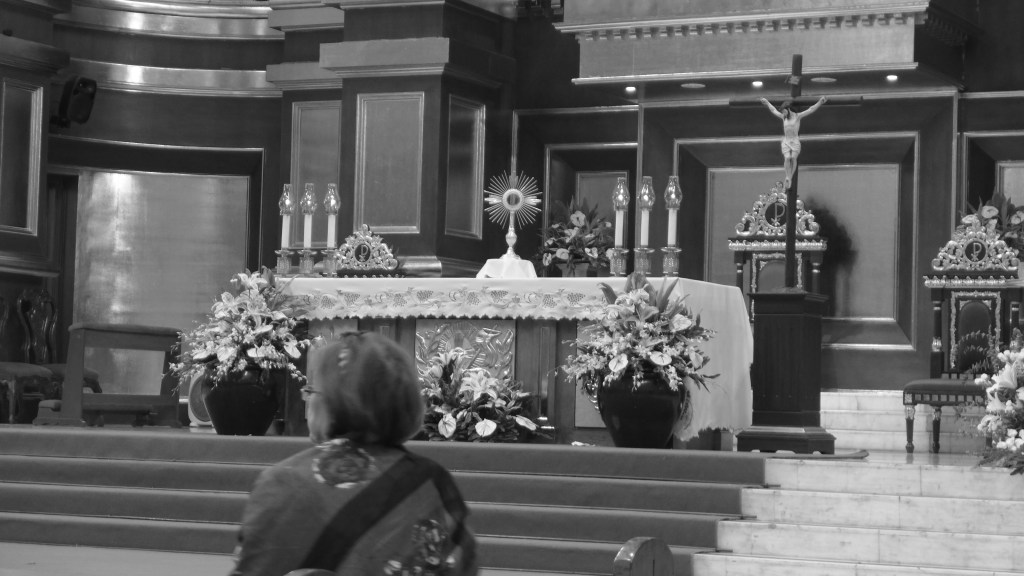
I think back to those scenes from my childhood: knees on the pavement of Baclaran, sad faces, hands reaching for the feet of saints. Those were postures of begging, and begging is real, but it is half of the conversation. What I couldn’t see as a boy was the other half, the turning that happens while praying in silence, where nothing visible changes and yet something does.
So I end this by encouraging you in your quiet moments of prayer with God: as you turn around, tell Him—
I need you now tonight
And I need you more than ever
And if you only hold me tight
We’ll be holding on forever
So Turn around.