I examine ideas, challenge assumptions, and connect experience with principles to uncover insights that help people and organizations grow. #Business #Leadership #Human Formation
My journey over the past few months has led me to a deeper realization: people who are wounded in spirit do not easily change, and it is not our role to change them. That belongs to God’s grace.
Yet they are not without purpose. They can become doorways that lead us closer to God—opportunities to practice kindness, understanding, and patience, while remaining steadfast in the truth.
When we choose to encounter even the toxic, the dishonest, and the mean-spirited with this disposition, something within us is transformed.
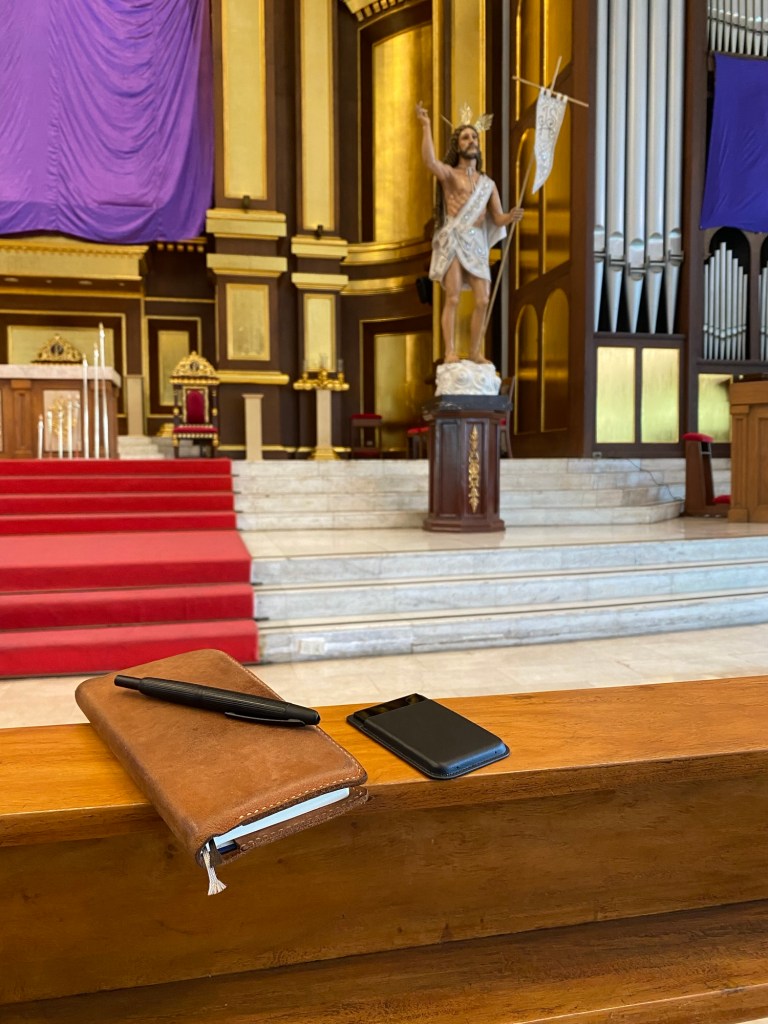
We woke up at 4:30 a.m. today for the Chrism Mass at Cubao Cathedral. It’s the Mass where the bishop consecrates the Sacred Chrism and blesses the Oils of the Sick and Catechumens.
The Cathedral, dedicated to the Immaculate Conception, is majestic—blue and gold with touches of red all around.
After the two-hour Mass, we had breakfast at Buttery & Co. with heads of different ministries, priests, and the former bishop of Cubao.
They said it was the only restaurant open in the area. Good for them—they captured the market. It made me think: opening during a holiday like Holy Week is a test of your brand. If you’re the only one open and people come, it means your business is needed. But if you open and no one comes, then maybe you’re not that relevant to your market.
After lunch, we went home to rest and do a few chores. Later on, I spontaneously decided to visit my cousin who works at Petron Starbucks along NLEX. We stayed there for a couple of hours until the sky turned fiery.
Golden hour felt like a small celebration. Families were in the parking lot having picnics—talking, laughing, just enjoying each other’s company. I thought it was very Filipino. Simple, practical, and meaningful—saving money while spending time together.
On the way home, I took the Marilao exit. Ingrid mentioned that a friend lives nearby. We thought of dropping by, but since it’s a solemn day, we didn’t want to disturb them. Instead, we went to Christ the King to pray. Since I still had some energy, we visited a few more churches, although we weren’t able to complete the Bisita Iglesia because I was already tired.
Thinking about it, I spent hours inside the car—talking with Ingrid, sharing stories, even venting a bit. Somehow, the car became our own quiet space of prayer—a kind of Garden of Gethsemane—where God listens to our thoughts, worries, and hopes.
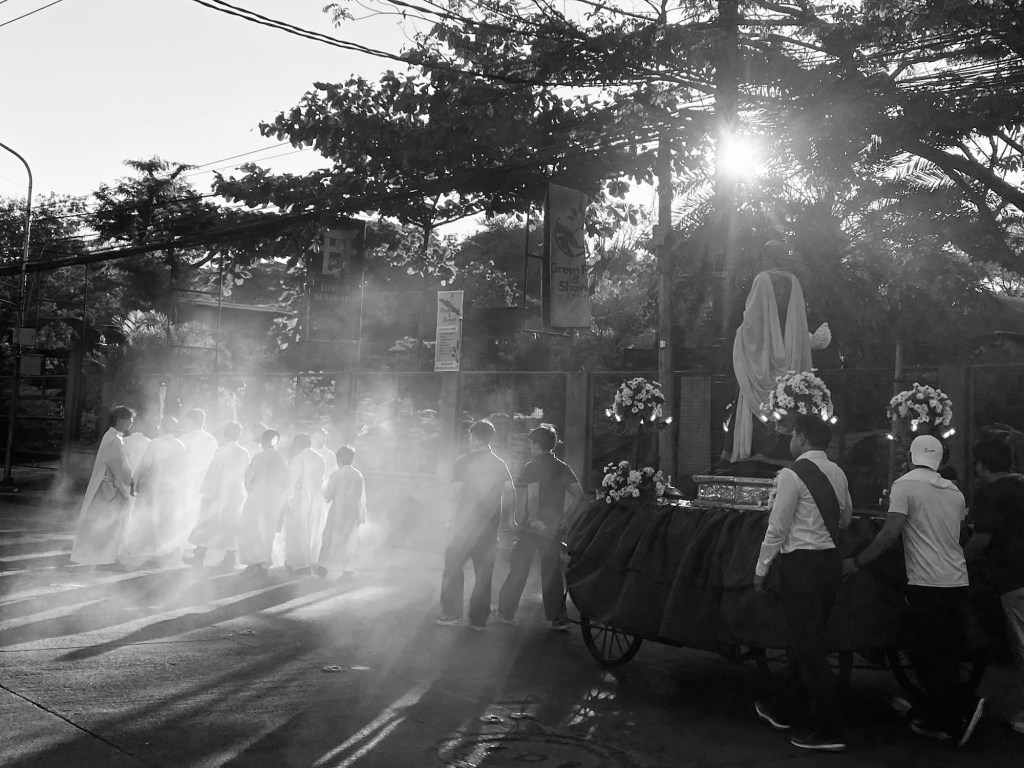
Today felt like Maundy Thursday unfolding throughout the day—from the Eucharist, to sharing a meal, to moments of prayer even inside the car, and the journey from one place to another.
I journeyed with Christ, not in the usual way, but in a way that brought the sacred into ordinary moments.
The darkness and silence between the crucifixion and the resurrection were filled with confusion and uncertainty for the disciples. That darkness was blinding, and the silence was deafening—not just in intensity, but in the loss of clarity and meaning. They could no longer make sense of what had happened.
In life, we experience similar moments. There are situations we simply cannot understand—realities that disturb us and challenge our sense of what is right or reasonable. Like the story shared by Fr. Cancino: an 86-year-old mother searching for her drug-addicted son, eventually finding him in a jeepney parking area. When the son refused to go home, the mother chose instead to stay with him, even sleeping there by his side.
Faced with this, we naturally form different opinions. Some may see it as enabling. Others may see it as heroic love. The situation resists easy judgment. It places us in a kind of darkness—where clarity escapes us and certainty is out of reach.
The same can be said of more difficult and uncomfortable realities: a whitewasher—someone who hides another’s faults by presenting a falsely positive image, making them appear better than they truly are. It becomes even more perplexing when this distortion comes from within the family itself, when a relative tells these untruths to their own loved ones. Here too, we are confronted with situations that resist easy explanation or resolution, where love itself can seem distorted and unclear.
And it is precisely in this kind of darkness and silence—where God seems absent and understanding fails—that faith invites us to a deeper stance. Not immediate answers, but trust. Not clarity, but presence.
Holy Saturday teaches us this: even when we cannot see or explain what is happening, God is not absent. He is at work in ways hidden from us. The silence is not empty, and the darkness is not without meaning. It may not yet be revealed—but it is not without purpose.
The story is simple: a power-tripping, credit-grabbing head of sales expects to be promoted to CEO—but instead, the role is given to Wally, a loyal, diligent, and honest janitor.
The message is clear: character matters.
And it’s a good message. In a world where ambition often overshadows integrity, it reminds us that goodness should not be overlooked.
But the story feels incomplete.
It presents a moral truth, but skips an important reality: leadership requires both character and competence. The film jumps from “good janitor” to “CEO” without showing the formation in between—no skills development, no training, no preparation. Viewers might walk away thinking that being good is enough to rise to the top.
In real life, it doesn’t work that way.
Character builds trust—but competence delivers results. One opens the door; the other sustains you in the role.
I’ve seen people rise from the ranks—even from roles like maintenance or janitorial work. But it took years of growth, learning, and deliberate development. I know this firsthand. I once promoted someone from maintenance to service, then to assistant head, until he eventually became a center manager. His character mattered—but so did the skills he built along the way.
This is why the idea of choosing between character and competence is a false dichotomy.
You don’t have to choose one over the other. The real goal is to develop both.
Because while promotions based on character may inspire people, promotions based on character and competence build organizations.