
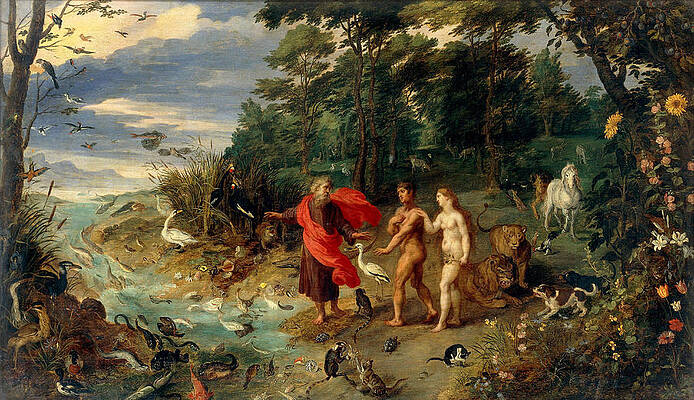
I fell in and out of sleep during the online video session of Jeff Cavins’ Unlocking the Mystery of the Bible series. Today, we were covering Creation. I would write notes for a few minutes, then fall asleep, wake up again, write some more, and then drift off once more. The cycle continued until the group returned to plenary.
This was only our second class, which Ingrid and I signed up for, and we still have a few more Mondays to go. The first session was more of an introduction than a class, simply explaining what to expect from the series.
The session did not become truly engaging until the plenary discussion, where classmates answered some of the reflection questions. The questions were rarely answered directly. One person would respond, another would offer an opinion, and the conversation would branch into different topics.
One particularly good question—obviously not part of the official discussion guide—was this: If God made Adam and Eve in His image and likeness, why did they disobey? Following that logic, does that make God imperfect? The person who asked it was genuinely curious, as she made clear, and not merely being pilosopo.
When I heard it, I thought it was an excellent question.
People began offering answers, but no one seemed entirely convinced by them—not even the one who asked. Someone answered that it was because of free will. While I think that is correct, the answer felt incomplete. Another said that it was simply God’s design and that we should accept it. To me, that was the least convincing response of all.
My mind then wandered to Lucifer.
God created Lucifer as a beautiful angel, yet he rebelled. A high-ranking angel became proud and desired a status that belonged to God alone. Instead of receiving his existence and glory as a gift, he sought self-exaltation. But why? Where did the idea of rebellion come from if angels were created good?
While angels were created good, like us, they also possess free will. However, their free will differs from ours. Angels possess a clarity and fullness of understanding that human beings do not. We often make decisions based on incomplete information. We are influenced by bodily needs, emotions, passions, and weaknesses. Angels, being purely spiritual beings, are not.
That is why their choices are fundamentally definitive. When angels chose for or against God, they did so with a clarity that humans do not possess. Because of this, their choice became irrevocable. The good angels became forever united to God, while the fallen angels permanently rejected Him.
The idea of rebellion did not come from God or created by God. Lucifer did not discover evil but rather freely turned away from the proper order of love. His will became curved inward toward himself. Why he did so remains a mystery. Free will explains how rebellion was possible, but not fully why a free creature would choose itself over God.
Going back to the original question, being made in the image and likeness of God does not mean Adam and Eve were like God in the sense of being perfect or incapable of doing wrong. According to St. Irenaeus of Lyons, the image is what humans are by creation: our reason, free will, and capacity to know God. This remains even after the Fall. While the likeness is what humans are called to become through union with God: spiritual maturity, holiness, and becoming more like God. This was damaged or lost through sin and must be restored through God’s grace.
Under this view, Adam and Eve were created good and innocent, but not yet perfected. The acorn remains an oak even if growth is interrupted, but it has not yet reached its fulfillment. They still had to freely choose God. The temptation in Eden became the turning point. Eve was promised that she would be “like God” if she ate the fruit, and she did.
So, to be made in God’s image and likeness does not mean becoming equal to God or losing free will. Rather, it means becoming more like God in character and love while remaining human. Since love requires freedom, the possibility of choosing wrongly remains part of what it means to be a free creature.
In Jeff Cavins’ video, he explained that when we place our trust in created things rather than in God, it becomes idolatry. In the case of Adam and Eve, they turned their gaze from the Giver to the gift. In the case of Lucifer, he turned his gaze from the Giver to himself. In both cases, the creature became more important than the Creator. The deeper temptation was to place one’s own will above God’s and to say, in the words of Frank Sinatra, “I did it my way.”
The discussion was engaging. I wanted to join the conversation, but I also wanted time to think. Had I spoken immediately, I might have made a fool of myself by blurting out half-formed ideas. Fortunately, I decided not to. A few minutes later, the session ended.
Thinking about it afterward, perhaps Al Pacino was right in The Devil’s Advocate when he said:
“Vanity… definitely my favorite sin.”

