
Just one hour from the bustling city of Barcelona is the breathtaking Mount Montserrat, a place where nature’s grandeur harmonizes with spiritual enlightenment.

Montserrat

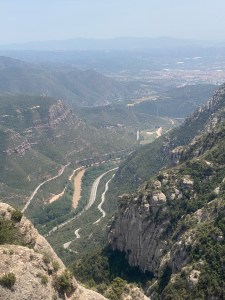
From top, looking down
Nestled atop the serrated mountain is Montserrat Basilica, a significant religious attraction drawing pilgrims from different parts of Europe and the rest of the world. Constructed in the 1500s, the church is of Gothic architecture adorned with touches of renaissance design. Unfortunately, it suffered heavily during the Peninsular War but was then given due treatment when it was reconstructed after the Spanish Civil War.

Basilica
The presence of the Black Madonna, or the Moreneta which is how they call it in Spain is the main reason people come to visit the Basilica of Montserrat. Many agree that the Madonna has healing powers and thousands of miracles has been credited to her. Thought there is no known origin of the statue, it is believed that the Moreneta has been carved in Jerusalem at the beginning of religion. And the reason it is black is because the wood has darkened over time. In 1844, Pope Leo XIII declared the Black Madonna to be the patron saint of Catalonia, making it even more important to the people of Spain.
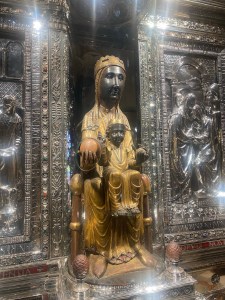
The Black Madonna
The lady is well loved by saints. In March 25, 1522, Ignatius of Loyola visited the Benedictine monastery of Montserrat upon his recovery from battle wounds. This is the place where he laid down his military paraphernalia before the lady’s image. Another is St. Escriva who often visited the image during the 1940s and even more in 1946, the year of his move to Rome. On April 27, 1954, on the feast of the lady of Montserrat, after having suffered diabetes for 10 years, and following an anaphylactic shock from wrong dose of insulin, he was fully healed. The saint’s doctor was astonished since most cases of insulin reaction are fatal.
Our group lined up along the right side of the church for the 130pm visit even if we arrived 2 hours earlier. The delay was not caused by long lines of people but unmet expectations, miscommunication caused by misrepresentation that annoyed me greatly since a lot of time was wasted. Anyway, it is a paid visit inside the church and the amount depends on areas you want to visit. As we entered, we were greeted by the atrium of the basilica, also known as atrium of Abbot Argerich. It’s white marble floor with inscriptions in Latin was inspired by Rome’s Capitolium, designed by Michaelangelo. Looking up from the atrium you will see the facade of the church with Jesus and the 12 apostles.
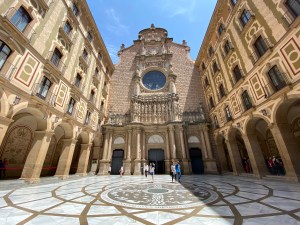
Atrium

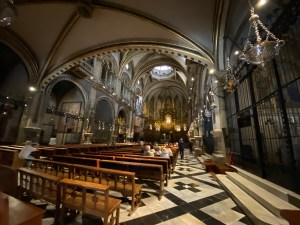

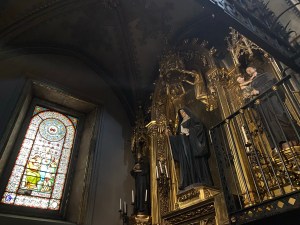
As we entered the right hall, statues of Saints welcomed us. After a few steps we found ourselves going up to the second floor and along its walls are vibrant mosaics of important Catholic figures. There was a bit of a traffic along the way as people paid their respects to the Black Madonna. A few minutes into the line, we reached the room where the Madonna is, said some prayers and took photos to remember the moment. A 180 degree turn from the Madonna, you will see the whole of the Basilica from birds eye view. Pews are dotted with people praying, and some walking along the isle to document their visit. Along the sides of church you will find candle chandeliers representative of Catalan jewelry-making after the Spanish civil war, donated by Catalan towns and associations.


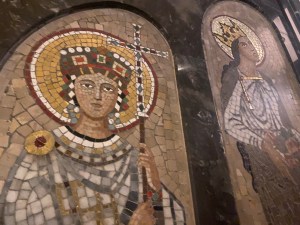

After the short prayer, we went down the stairs only to find ourselves, which to me is the most beautiful part of the basilica, the chapel behind the Black Madonna. The majestic circular space, surrounded by colorful stained glass windows, an embodiment of God’s beauty and perfection is spiritually inviting, a direct call from the divine.


Chandelier
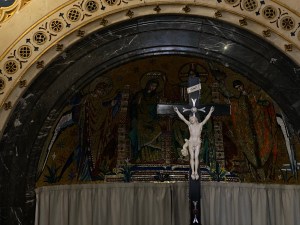


Before we reached the atrium to end the visit, we had to pass through the side of the basilica, a space lit with candles contained in different colors, symbolic of hundreds of prayer and praises from people grateful for having seen and touched the divine in the beauty of the church, the truth in the feeling of God’s presence and the goodness of Moreneta.
 Panorama